Thursday, 3 August 2017

Exam System project java ~ foundjava

Online Exam Project in Java Swing without database

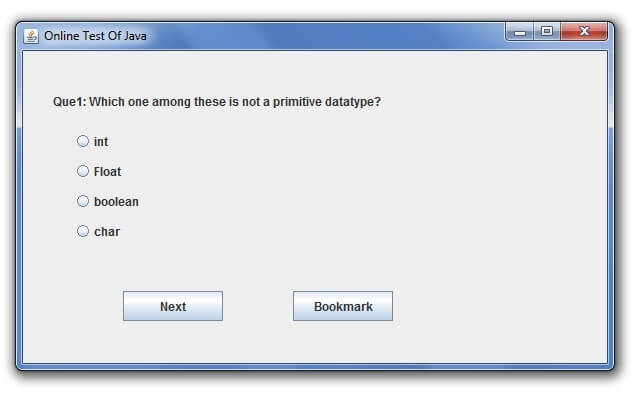
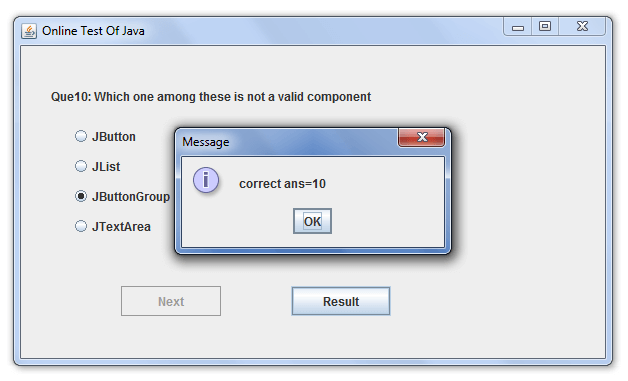
In this project, there are given 10 questions to play. User can bookmark any question for the reconsideration while going to result.
We are using here java array to store the questions, options and answers not database. You can use collection framework or database in place of array.
  1. /*Online Java Paper Test*/  
  2.   
  3. import java.awt.*;  
  4. import java.awt.event.*;  
  5. import javax.swing.*;  
  6.   
  7. class OnlineTest extends JFrame implements ActionListener  
  8. {  
  9.     JLabel l;  
  10.     JRadioButton jb[]=new JRadioButton[5];  
  11.     JButton b1,b2;  
  12.     ButtonGroup bg;  
  13.     int count=0,current=0,x=1,y=1,now=0;  
  14.     int m[]=new int[10];      
  15.     OnlineTest(String s)  
  16.     {  
  17.         super(s);  
  18.         l=new JLabel();  
  19.         add(l);  
  20.         bg=new ButtonGroup();  
  21.         for(int i=0;i<5;i++)  
  22.         {  
  23.             jb[i]=new JRadioButton();     
  24.             add(jb[i]);  
  25.             bg.add(jb[i]);  
  26.         }  
  27.         b1=new JButton("Next");  
  28.         b2=new JButton("Bookmark");  
  29.         b1.addActionListener(this);  
  30.         b2.addActionListener(this);  
  31.         add(b1);add(b2);  
  32.         set();  
  33.         l.setBounds(30,40,450,20);  
  34.         jb[0].setBounds(50,80,100,20);  
  35.         jb[1].setBounds(50,110,100,20);  
  36.         jb[2].setBounds(50,140,100,20);  
  37.         jb[3].setBounds(50,170,100,20);  
  38.         b1.setBounds(100,240,100,30);  
  39.         b2.setBounds(270,240,100,30);  
  40.         setDefaultCloseOperation(JFrame.EXIT_ON_CLOSE);  
  41.         setLayout(null);  
  42.         setLocation(250,100);  
  43.         setVisible(true);  
  44.         setSize(600,350);  
  45.     }  
  46.     public void actionPerformed(ActionEvent e)  
  47.     {  
  48.         if(e.getSource()==b1)  
  49.         {  
  50.             if(check())  
  51.                 count=count+1;  
  52.             current++;  
  53.             set();    
  54.             if(current==9)  
  55.             {  
  56.                 b1.setEnabled(false);  
  57.                 b2.setText("Result");  
  58.             }  
  59.         }  
  60.         if(e.getActionCommand().equals("Bookmark"))  
  61.         {  
  62.             JButton bk=new JButton("Bookmark"+x);  
  63.             bk.setBounds(480,20+30*x,100,30);  
  64.             add(bk);  
  65.             bk.addActionListener(this);  
  66.             m[x]=current;  
  67.             x++;  
  68.             current++;  
  69.             set();    
  70.             if(current==9)  
  71.                 b2.setText("Result");  
  72.             setVisible(false);  
  73.             setVisible(true);  
  74.         }  
  75.         for(int i=0,y=1;i<x;i++,y++)  
  76.         {  
  77.         if(e.getActionCommand().equals("Bookmark"+y))  
  78.         {  
  79.             if(check())  
  80.                 count=count+1;  
  81.             now=current;  
  82.             current=m[y];  
  83.             set();  
  84.             ((JButton)e.getSource()).setEnabled(false);  
  85.             current=now;  
  86.         }  
  87.         }  
  88.       
  89.         if(e.getActionCommand().equals("Result"))  
  90.         {  
  91.             if(check())  
  92.                 count=count+1;  
  93.             current++;  
  94.             //System.out.println("correct ans="+count);  
  95.             JOptionPane.showMessageDialog(this,"correct ans="+count);  
  96.             System.exit(0);  
  97.         }  
  98.     }  
  99.     void set()  
  100.     {  
  101.         jb[4].setSelected(true);  
  102.         if(current==0)  
  103.         {  
  104.             l.setText("Que1: Which one among these is not a primitive datatype?");  
  105.             jb[0].setText("int");jb[1].setText("Float");jb[2].setText("boolean");jb[3].setText("char");   
  106.         }  
  107.         if(current==1)  
  108.         {  
  109.             l.setText("Que2: Which class is available to all the class automatically?");  
  110.             jb[0].setText("Swing");jb[1].setText("Applet");jb[2].setText("Object");jb[3].setText("ActionEvent");  
  111.         }  
  112.         if(current==2)  
  113.         {  
  114.             l.setText("Que3: Which package is directly available to our class without importing it?");  
  115.             jb[0].setText("swing");jb[1].setText("applet");jb[2].setText("net");jb[3].setText("lang");  
  116.         }  
  117.         if(current==3)  
  118.         {  
  119.             l.setText("Que4: String class is defined in which package?");  
  120.             jb[0].setText("lang");jb[1].setText("Swing");jb[2].setText("Applet");jb[3].setText("awt");  
  121.         }  
  122.         if(current==4)  
  123.         {  
  124.             l.setText("Que5: Which institute is best for java coaching?");  
  125.             jb[0].setText("Utek");jb[1].setText("Aptech");jb[2].setText("SSS IT");jb[3].setText("jtek");  
  126.         }  
  127.         if(current==5)  
  128.         {  
  129.             l.setText("Que6: Which one among these is not a keyword?");  
  130.             jb[0].setText("class");jb[1].setText("int");jb[2].setText("get");jb[3].setText("if");  
  131.         }  
  132.         if(current==6)  
  133.         {  
  134.             l.setText("Que7: Which one among these is not a class? ");  
  135.             jb[0].setText("Swing");jb[1].setText("Actionperformed");jb[2].setText("ActionEvent");  
  136.                         jb[3].setText("Button");  
  137.         }  
  138.         if(current==7)  
  139.         {  
  140.             l.setText("Que8: which one among these is not a function of Object class?");  
  141.             jb[0].setText("toString");jb[1].setText("finalize");jb[2].setText("equals");  
  142.                         jb[3].setText("getDocumentBase");         
  143.         }  
  144.         if(current==8)  
  145.         {  
  146.             l.setText("Que9: which function is not present in Applet class?");  
  147.             jb[0].setText("init");jb[1].setText("main");jb[2].setText("start");jb[3].setText("destroy");  
  148.         }  
  149.         if(current==9)  
  150.         {  
  151.             l.setText("Que10: Which one among these is not a valid component?");  
  152.             jb[0].setText("JButton");jb[1].setText("JList");jb[2].setText("JButtonGroup");  
  153.                         jb[3].setText("JTextArea");  
  154.         }  
  155.         l.setBounds(30,40,450,20);  
  156.         for(int i=0,j=0;i<=90;i+=30,j++)  
  157.             jb[j].setBounds(50,80+i,200,20);  
  158.     }  
  159.     boolean check()  
  160.     {  
  161.         if(current==0)  
  162.             return(jb[1].isSelected());  
  163.         if(current==1)  
  164.             return(jb[2].isSelected());  
  165.         if(current==2)  
  166.             return(jb[3].isSelected());  
  167.         if(current==3)  
  168.             return(jb[0].isSelected());  
  169.         if(current==4)  
  170.             return(jb[2].isSelected());  
  171.         if(current==5)  
  172.             return(jb[2].isSelected());  
  173.         if(current==6)  
  174.             return(jb[1].isSelected());  
  175.         if(current==7)  
  176.             return(jb[3].isSelected());  
  177.         if(current==8)  
  178.             return(jb[1].isSelected());  
  179.         if(current==9)  
  180.             return(jb[2].isSelected());  
  181.         return false;  
  182.     }  
  183.     public static void main(String s[])  
  184.     {  
  185.         new OnlineTest("Online Test Of Java");  
  186.     }  
  187. }  

Output

online exam project in swing output 1 online exam project in swing output 1
Read More »

Java Application World (JApps) Project ~ foundjava

Download Source Code

Objective/ Vision

A Java Application World software where user can use applications developed in Java such as calculator, notepad+, puzzle game, ip finder, word count tool, source code generator, picture puzzle game, tic tac toe game and exam system.

Users of the System

  1. User

Functional Requirements

1. User
  1. Can use calculator
  2. Can use notepad+
  3. Can use puzzle game
  4. Can use picture puzzle game
  5. Can use tic tac toe game
  6. Can use ip finder
  7. Can use word count tool
  8. Can use source code generator
  9. Can use exam system

Tools to be used

  1. Use any IDE to develop the project. It may be Eclipse /Myeclipse / Netbeans etc.

Front End and Back End

  1. Front End: Java Swing
  2. Back End: No

Screenshot

Some screenshots are given below:
japps 1 japps 2 japps 3

How to run this project

Double click on the runnable jar file JApps.jar.
Read More »

Fee Report project java ~ foundjava

Fee Report | Student Management System in Java


Download Source Code

Objective/ Vision

A fee report software where admin can add/view/delete accountant and accountant can add/view/edit/delete student, check due fee and logout.

Users of the System

  1. Admin
  2. Accountant

Functional Requirements

1. Admin
  1. Can add/view/edit/delete accountant
  2. Can logout
2. Accountant
  1. Can add/view/edit/delete students
  2. Can check due fee
  3. Can logout

Tools to be used

  1. Use any IDE to develop the project. It may be Eclipse /Myeclipse / Netbeans etc.
  2. MySQL for the database.

Front End and Back End

  1. Front End: Java Swing
  2. Back End: MySQL

How project works?

To get detail explanation about project, download the document file. It includes snapshots with explanation.
Some screenshots are given below:
fee report project in java 1 student management system in java 2 student management project in java swing 3 fee report project in java 4 fee report project in java 5fee report project in java 7 fee report project in java 8 fee report project in java 12

How to run this project

Import sql files to create tables in mysql.
Import the project on the Eclipse IDE and run it.
Read More »

Fee Management Project in Servlet ~ foundjava

Fee Management Project in Servlet


Download Source Code

Objective/ Vision

A fee management application where admin can add/edit/view/delete accountant and accountant can add/view/edit/delete student, check due fee and logout.

Users of the System

  1. Admin
  2. Accountant

Functional Requirements

1. Admin
  1. Can login
  2. Can add/view/edit/delete accountant
  3. Can logout
2. Accountant
  1. Can login
  2. Can add/view/edit/delete students
  3. Can check due fee
  4. Can logout

Tools to be used

  1. Use any IDE to develop the project. It may be Eclipse /Myeclipse / Netbeans etc.
  2. Oracle or MySQL for the database. Here we are using Oracle 10g database. Assuming that username is system and password is oracle.

Front End and Back End

  1. Front End: Servlet with HTML5, CSS and Bootstrap
  2. Back End: Oracle 10g

How project works?

To get detail explanation about project, download the document file. It includes snapshots with explanation.
Some screenshots are given below:
fee report project in servlet 1fee report project in servlet 2fee report project in servlet 3fee report project in servlet 4fee report project in servlet 5

How to run this project

Create fee_accountant and fee_student tables in Oracle 10g database. Here id column for fee_accountant and rollno for fee_student must be generated using sequence.
Import the project on the Eclipse IDE and run it.

Read More »

eLibrary Project in Servle ~ foundjava

eLibrary Project in Servlet


Download Source Code

Objective/ Vision

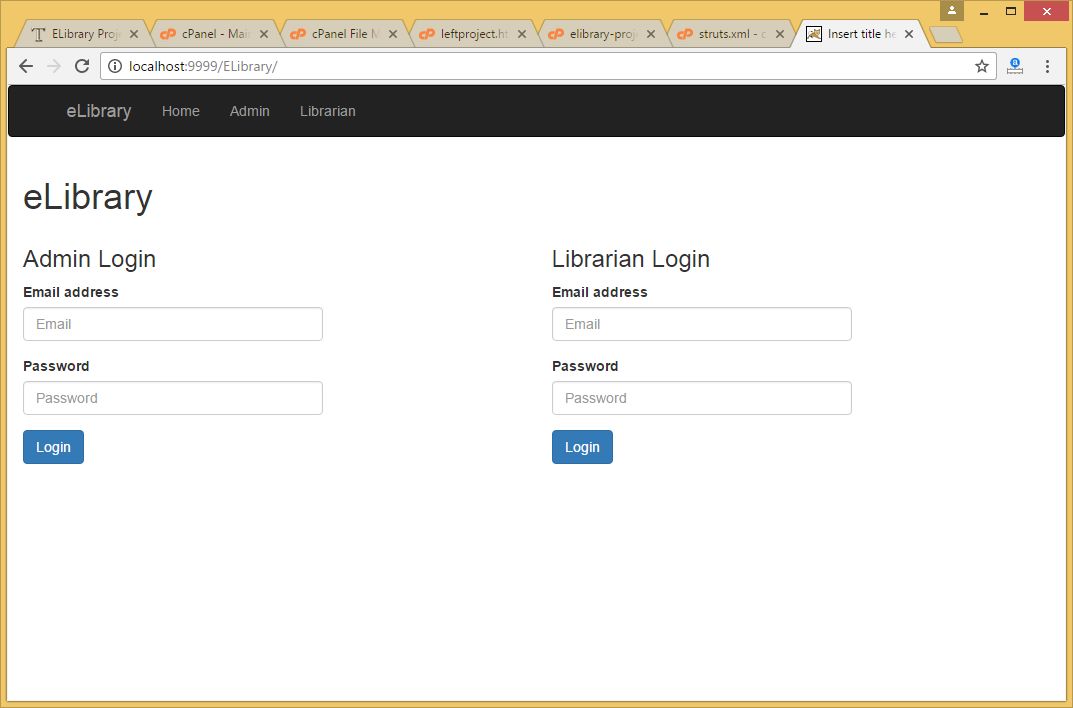
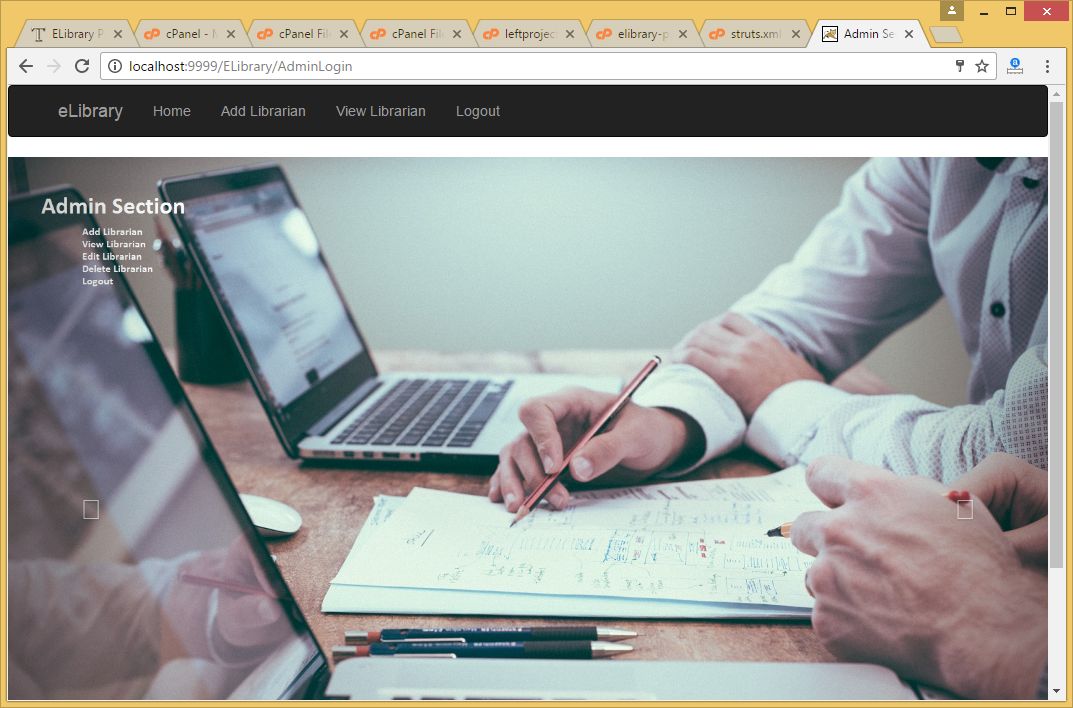
A library management software where admin can add/view/delete librarian and librarian can add/view books, issue, view issued books and return books.

Users of the System

  1. Admin
  2. Libraian

Functional Requirements

1. Admin
  1. Can add/edit/view/delete librarian
  2. Can logout
2. Librarian
  1. Can add/edit/delete/view books
  2. Can issue books
  3. View issued books
  4. Return Books
  5. Can logout

Tools to be used

  1. Use any IDE to develop the project. It may be Eclipse /Myeclipse / Netbeans etc.
  2. Oracle/MySQL for the database.

Front End and Back End

  1. Front End: Servlet, HTML, CSS, Bootstrap
  2. Back End: Oracle

How project works?

To get detail explanation about project download the document file. It includes snapshots with explanation.
Some screenshots are given below:
library management project in servlet 1library management project in servlet 1library management project in servlet 1

How to run this project

Open tablesoracle.sql file located inside projectfolder/WebContent. See the table query there. Create each table manually in Oracle database.
Import the project on the Eclipse IDE and run it.
Use admin@jtp.com and admin123 for username and password of admin.
Read More »

Data is eating the software that is eating the world ~ foundjava

No one doubts that software engineering shapes every last facet of our 21stcentury existence. Given his vested interest in companies whose fortunes were built on software engineering, it was no surprise when Marc Andreessen declared that “software is eating the world.”
But what does that actually mean, and, just as important, does it still apply, if it ever did? These questions came to me recently when I reread Andreessen’s op-ed piece and noticed that he equated “software” with “programming.” Just as significant, he equated “eating” with industry takeovers by “Silicon Valley-style entrepreneurial technology companies” and then rattled through the usual honor roll of Amazon, Netflix, Apple, Google, and the like. What they, and others cited by Andreessen, have in common is that they built global-scale business models on the backs of programmers who bang out the code that drives web, mobile, social, cloud, and other 24/7 online channels.
Since the piece was published in the Wall Street Journal in 2011, we’ve had more than a half-decade to see whether Andreessen’s epic statement of Silicon Valley triumphalism proved either prescient or, perhaps, merely self-serving and misguided. I’d say it comes down more on the prescient end of the spectrum, due to the fact that most (but not all) of the success stories he cited have continued their momentum in growth, profitability, acquisitions, innovation, and so forth. People from programming backgrounds – such as Mark Zuckerberg – are indeed the multibillionaire rockstars of this new business era. In this way, Andreessen has so far been spared the fate of Tom Peters, who saw many of the exemplars he cited in his 1982 bestseller “In Search of Excellence” go on to be deconstructed by business rivals or blindsided by trends they didn’t see coming.
Rise of the learning machines
AI and the Goliaths
However, it has become clear to everyone, especially the old-school disruptors cited by Andreessen, that “software,” as it’s normally understood, is not the secret to future success. Going forward, the agent of disruption will be the data-driven ML (machine learning) algorithms that power AI. In this new era, more of the logic that powers intelligent applications won’t be explicitly programmed. The days of predominantly declarative, deterministic, and rules-based application development are fast drawing to a close. Instead, the probabilistic logic at the heart of chatbots, recommendation engines, self-driving vehicles, and other AI-powered applications is being harvested directly from source data.
The “next best action” logic permeating our lives is evolving inside of applications through continuous inference from data originating in the Internet of Things and other production applications. Consequently, there will be a diminishing need for programmers, in the traditional sense of people who build hard-and-fast application logic. In their place, the demand for a new breed of developer – the data scientist – will continue to grow. This term refers to the wide range of specialists who craft, train, and manage the regression models, neural networks, support vector machines, unsupervised learning models, and other ML algorithms upon which AI-centric apps depend.
To compound the marginalization of programmers in this new era, we’re likely to see more ML-driven code generation along the lines that I discussed in this recent post. Amazon, Google, Facebook, Microsoft, and other software-based powerhouses have made huge investments in data science, hoping to buoy their fortunes in the post-programming era. They all have amassed growing sets of training data from their ongoing operations. For these reasons, the “Silicon Valley-style” monoliths are confident that they have the resources needed to build, tune, and optimize increasingly innovative AI/ML-based algorithms for every conceivable application.
However, any strategic advantages that these giants gain from these AI/ML assets may be short-lived. Just as data-driven approaches are eroding the foundations of traditional programming, they’re also beginning to nibble at the edges of what highly skilled data scientists do for a living. These trends are even starting to chip away at the economies of scale available to large software companies with deep pockets.
We’re moving into an era in which anyone can tap into cloud-based resources to cheaply automate the development, deployment, and optimization of innovative AI/ML apps. In a “snake eating its own tail” phenomenon, ML-driven approaches will increasingly automate the creation and optimization of ML models, per my discussion here. And, from what we’re seeing in research initiatives such as Stanford’s Snorkel project, ML will also play a growing role in automating the acquisition and labeling of ML training data. What that means is that, in addition to abundant open-source algorithms, models, code, and data, the next-generation developer will also be able to generate ersatz but good-enough labeled training data on the fly to tune new apps for their intended purposes.
As the availability of low-cost generative training data grows, the established software companies’ massive data lakes, in which their developers maintain petabytes of authentic from-the-source training data, may become more of an overhead burden than a strategic asset. Likewise, the need to manage the complex data-preparation logic for use of this source data may become a bottleneck that impedes the ability of developers to rapidly build, train, and deploy new AI apps.
When any developer can routinely make AI apps just as accurate as Google’s or Facebook’s – but with far less expertise, budget, and training data than the big shots – a new era will have dawned. When we reach that tipping point, the next generation of data-science-powered disruptors will start to eat away at yesteryear’s software startups.
This story, "Data is eating the software that is eating the world" was originally published by InfoWorld.
Read More »